
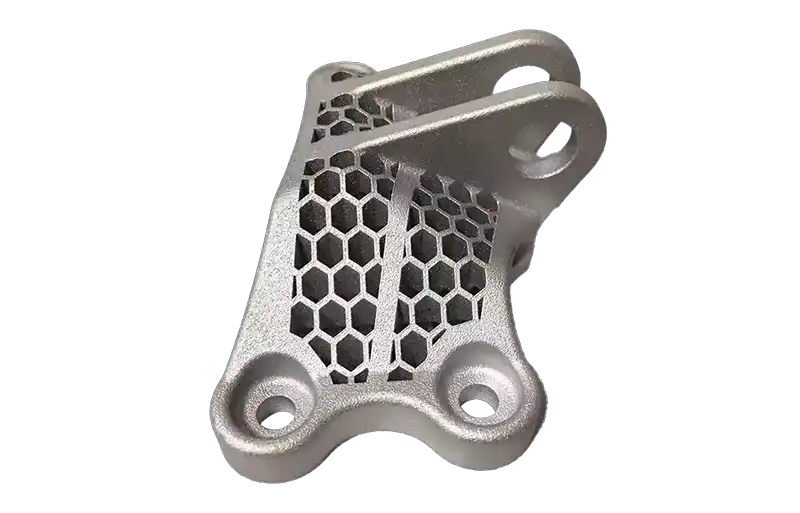
Metal 3D printing, also known as additive manufacturing, has become an indispensable manufacturing method alongside traditional CNC machining in modern metal fabrication. Unlike subtractive CNC machining that cuts material away from a solid block, metal 3D printing builds parts layer by layer using metal powders such as stainless steel, aluminum, titanium and Inconel.
This technology shines when producing components with complex internal channels, lattice structures or lightweight geometries that are difficult or even impossible to machine with standard CNC tools. It greatly reduces material waste, especially for high-value alloy parts, and shortens the lead time for custom prototypes and low-volume production.
Nevertheless, metal 3D printed parts usually require post-processing. CNC machining is commonly used to refine critical surfaces, achieve tight dimensional tolerances and smooth rough printed layers. The combination of these two processes delivers the best result: 3D printing realizes innovative complex shapes, while CNC machining guarantees precision and surface finish.
For manufacturers, choosing the right process or hybrid workflow depends on part geometry, batch size, cost target and tolerance requirements. Together, metal 3D printing and CNC machining expand the boundaries of what can be made, serving aerospace, medical, automotive and industrial equipment sectors efficiently.