
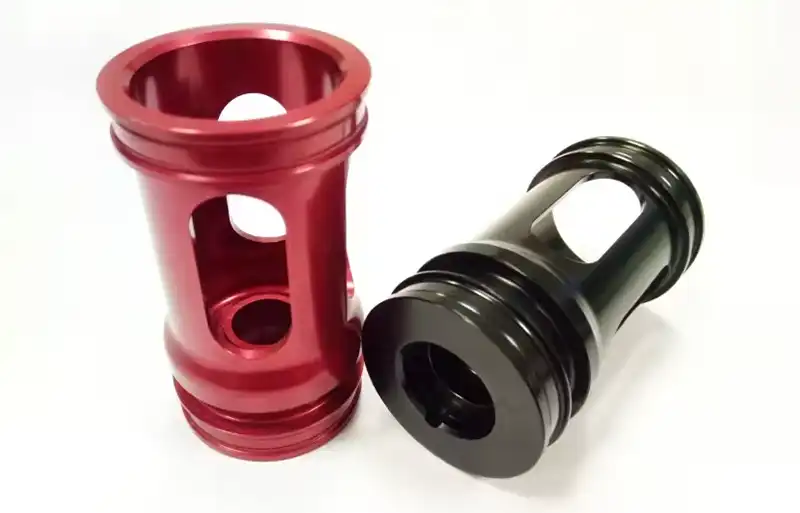
Aluminum is one of the most widely used metals in modern manufacturing due to its lightweight, corrosion resistance, and excellent machinability. However, raw aluminum surfaces are rarely suitable for end-use applications without additional finishing. Surface treatment enhances not only appearance but also durability, wear resistance, electrical properties, and environmental protection. This article explores the most common surface finishing options for aluminum parts and how to select the right one for your application.
Anodizing
Anodizing is the most popular finishing process for aluminum. It is an electrochemical procedure that thickens the natural oxide layer on the aluminum surface, creating a hard, durable, and corrosion-resistant coating. The process involves submerging the aluminum part in an acidic electrolyte bath and passing an electric current through it. Oxygen bubbles form at the anode (the aluminum part), reacting with aluminum ions to produce aluminum oxide (Al₂O₃).
There are two primary types of anodizing: Type II (sulphuric acid anodizing) and Type III (hard coat anodizing). Type II produces coatings typically 5 to 25 micrometers thick and is suitable for decorative and general industrial applications. It accepts a wide range of colors through dye absorption before sealing. Type III hard anodizing produces coatings up to 100 micrometers thick with surface hardness approaching that of sapphire, making it ideal for wear-resistant components such as piston rings, cylinder liners, and aerospace structural parts.
Anodized aluminum exhibits excellent adhesion for subsequent painting or bonding operations and maintains the dimensional integrity of the original part since the oxide layer grows outward from the substrate rather than being applied as a separate coating.
Powder Coating
Powder coating is a dry finishing process in which finely ground particles of pigment and resin are electrostatically sprayed onto the aluminum surface. The charged powder particles adhere to the grounded part, which is then cured under heat to form a smooth, uniform, and durable finish. Common curing temperatures range from 160°C to 200°C for approximately 10 to 20 minutes.
Powder coating produces a thicker protective layer — typically 60 to 120 micrometers — compared to conventional liquid paint, resulting in superior resistance to chipping, scratching, fading, and chemical exposure. The process generates virtually no volatile organic compound (VOC) emissions, making it environmentally friendly. A vast palette of colors, textures, and gloss levels is available, including metallic, matte, satin, and wrinkled finishes.
Powder coated aluminum is extensively used in architectural applications such as window frames, door panels, and curtain wall systems, where long-term weather resistance and aesthetic consistency are essential. It is also common in automotive trim, consumer electronics enclosures, and outdoor furniture.
Electroplating
Electroplating deposits a thin layer of metal — such as chrome, nickel, zinc, or gold — onto the aluminum surface through an electrolytic process. Because aluminum naturally forms an oxide layer that interferes with plating adhesion, specialized pretreatment involving zincate immersion or other activation steps is required before the plating bath.
Chrome plating provides a bright, reflective, and highly wear-resistant surface commonly used for automotive trim, bathroom fixtures, and decorative hardware. Nickel plating offers good corrosion resistance and can serve as an undercoat for chrome or as a standalone functional finish. Zinc plating provides sacrificial cathodic protection and is frequently applied to aluminum components exposed to harsh environments. Gold and silver plating are used in electronics for superior conductivity and contact resistance.
Electroplated aluminum parts must undergo rigorous quality testing to ensure plating adhesion, thickness uniformity, and porosity control, particularly when the finish will be subjected to mechanical stress or corrosive conditions.
Chemical Conversion Coating
Chemical conversion coatings are thin, non-metallic layers formed by reacting the aluminum surface with specific chemical solutions. The most common types include chromate conversion coating (historically known as Alodine or Iridite), phosphate conversion coating, and trivalent chrome conversion coating.
Chromate conversion coatings provide excellent corrosion resistance and serve as an ideal base coat for paint and powder coating systems. They are transparent to slightly yellow in color and add minimal dimension to the part. Due to environmental regulations restricting hexavalent chromium, many manufacturers have transitioned to trivalent chrome conversion coatings, which offer comparable performance with significantly reduced toxicity.
These coatings are widely used in aerospace and defense applications where paint adhesion and corrosion prevention are critical, and in electronic enclosures requiring electromagnetic interference (EMI) shielding compatibility.
Painting and Liquid Coatings
Conventional liquid paints — including solvent-based, water-based, and epoxy formulations — remain viable finishing options for aluminum, particularly when custom colors or specific performance characteristics are required. Proper surface preparation, including cleaning, degreasing, andapplication of a primer, is essential for achieving long-lasting adhesion.
Liquid paints generally produce thinner films than powder coatings and may require multiple coats for full coverage. They are commonly used for large structural components, industrial equipment housings, and artistic or architectural applications where bespoke color matching is necessary.
Selecting the Right Finish
Choosing the appropriate surface finish depends on several factors: the intended environment (indoor, outdoor, marine, chemical exposure), mechanical requirements (wear resistance, scratch resistance), aesthetic expectations (color, gloss, texture), electrical properties (conductivity, insulation), and budget constraints. Anodizing excels in durability and precision; powder coating offers superior impact and UV resistance; electroplating delivers unique metallic appearances and conductivity; and conversion coatings provide excellent paint adhesion with minimal cost. Consulting with experienced finishing providers ensures optimal selection for each specific application.