
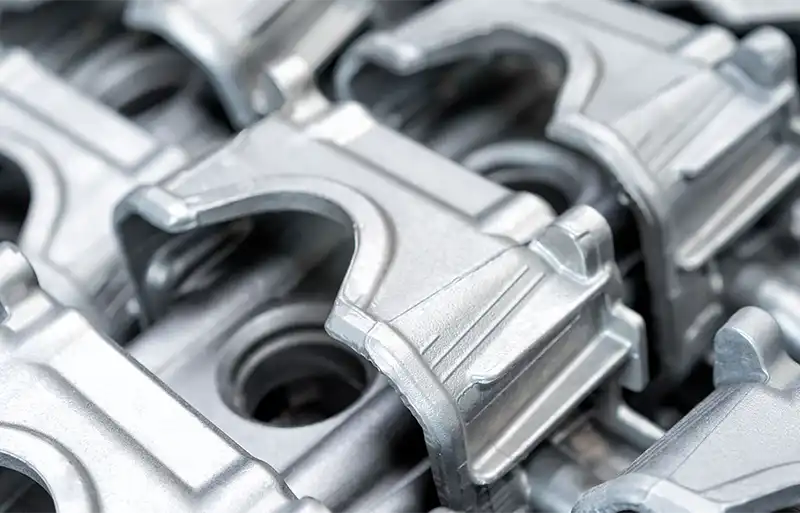
Die casting forms a part by forcing molten metal into a precision die under high speed and high pressure. The die is mounted on a die casting machine, and molten aluminium, magnesium or zinc is injected into the cavity. Because the cavity is machined to the shape of the part, complex three-dimensional geometry emerges in a single cycle rather than being machined away from solid stock.
The advantages of die casting
High-volume production is possible. Once a die is built, complex parts can be produced in quantity through a relatively short sequence of operations, which is the core reason die casting exists at all.
Complex shapes are practical. Building a die for a given product shape allows even difficult three-dimensional geometry to be produced without difficulty, provided the geometry can be cast.
Dimensional accuracy is higher than ordinary casting. Die castings hold tighter tolerances than sand or shell castings.
Less secondary machining is required. Compared with machining the same part from solid, a die casting typically reaches a higher yield because only deburring is usually needed to complete the part. This is a significant advantage in its own right.
Cost can be reduced. Although building a die from scratch demands real investment, that investment is recovered across the production run, and the possibility of further cost reduction exists once volume is established.
The advantage grows in exactly the situation it should. In a scenario requiring batch production of a complex part, die casting can produce it in fewer operations, and this is where the possibility of lower production cost comes from.
The limitations of die casting
Lower strength. Die castings typically develop internal voids known as casting porosity, so their strength is generally lower than that of the equivalent part machined from solid. Methods now exist to suppress porosity formation, but these methods tend to raise manufacturing cost.
High tooling cost makes small batches uneconomic. The die itself is expensive to manufacture, so the initial investment in a die casting programme is high. That cost is recovered through volume, which means die casting is fundamentally a manufacturing method unsuited to small batches. It also means the die life varies with the part: even in a volume production run, a particular part may shorten tool life and push cost sharply upward.
Some shapes cannot be made. Beyond tubular or hollow shapes, features such as internal protrusions or holes on the side face are also unsuitable for die casting.
Understanding porosity
Porosity is the single most discussed defect in die casting, and it is worth separating two mechanisms, because they have different causes and opposite remedies — a distinction that decides whether a process change helps or makes things worse.
Gas porosity forms when air is trapped as the metal fills the cavity. It is usually round or oval with a relatively smooth internal surface, and it appears where the flow folds over on itself or where separate streams of metal rejoin. The most common sources are air trapped in the shot sleeve during the slow shot, lubricant or moisture generating vapour, and hydrogen coming out of solution in aluminium.
Shrinkage porosity forms where contraction during solidification cannot be fed by additional liquid metal. Aluminium alloys shrink by roughly 4–7% by volume as they solidify. Thin walls freeze first, and a thick section that is still liquid has to be fed through the walls around it and through the gate. Once the gate or a thin wall on the feed path has frozen, the remaining liquid contracts with nothing to replace it, and a cavity opens. These voids are irregular, branched and dendritic, and they sit in the centre of thick sections, heavy bosses and rib-to-wall junctions.
The distinction is not academic. Intensification pressure is effective against shrinkage porosity and largely ineffective against gas porosity. Raising pressure to fix a gas defect adds risk of flash and die loading without solving the problem.
One point is worth clarifying, because it is often misread: a casting can look perfect as-cast and still contain porosity. Machining a sealing face or drilling a mounting hole frequently exposes a pore that was already there. The machining determines where the cavity becomes visible; it does not create it.
How die casting and machining differ, and where they connect
Machining removes material by cutting, drilling and milling. The two methods are fundamentally different, and each suits different products. Machining suits small batches and the samples that precede die-cast production. Die casting suits complex shapes and large quantities of identical parts. The choice between them is therefore a question of quantity and shape, not of quality.
In practice, the choice between them is made on the basis of part type and quantity, and a great deal of production uses both together.
Drawings state the dimensional tolerance grade for cast features and for machined features separately, which makes it possible to judge from the drawing whether die casting alone can hold the part, or whether machining has to be combined with it — including milling and drilling.
Notes on machining die castings
Die castings carry dimensional deviation, and two consequences follow.
Fixtures must account for that deviation. Workholding designed for a machined part will not necessarily hold a casting correctly, and the difference has to be built into the fixture design.
Cutting paths have to minimise the effect of chips. A casting has a skin that is not uniform, and a cutting sequence that leaves loose material in the cut can produce a variation that reads as a dimensional error.
There is a second, less obvious constraint. Die casting assumes batch production from the outset, and frequent inspection and maintenance are essential to avoid reducing machine utilisation. A die casting cell that is constantly opened for checks runs at a fraction of the output the same cell would achieve running a stable batch.
Part examples produced by die casting
Die castings are everywhere, and automotive parts are the largest single category. Within vehicles, die casting is used mainly for engine-related components.
| Material | Characteristics | Typical parts |
| Aluminium | Light weight, excellent dimensional stability | Engine brackets, transmission housings, valve plates, hydraulic cylinders |
| Zinc | High impact strength, good ductility | Door lock housings, seatbelt retractor gears, seatbelt pulleys |
| Magnesium | Light weight, supple and resilient, excellent heat resistance | Computer components, professional camera bodies |
Common alloys include A380, ADC12, A356 and AlSi10MnMg for aluminium, Zamak 3 and Zamak 5 for zinc, and AZ91D for magnesium.
Outside automotive, die castings appear in refrigerators, washing machines and vacuum cleaners, and in office equipment — copiers, printers and fax machines — as well as in computer chassis, peripherals and cameras. Die casting is one of those processes that quietly makes everyday products possible.
Combining die casting with machining
Die casting produces complex shapes quickly; machining allows fine adjustment. Using the two in combination produces parts that need both high dimensional accuracy and a wide range of production characteristics.
In a die casting programme, understanding the process’s advantages and limitations in advance is what makes it possible to manufacture better parts more efficiently. The fundamentals are worth knowing properly, because they apply to every production decision that follows.
Die casting and machining are not competing approaches. They occupy different points on the same cost and capability curve, and the practical skill lies in knowing which one a given part needs — and where the two should meet.