
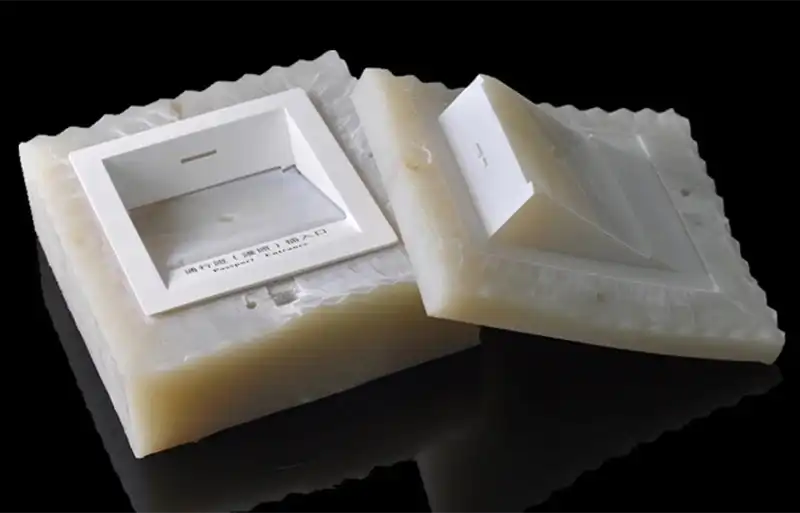
Vacuum casting is a fast and economical alternative for producing small batches of injection moulded parts. The typical route uses an SLA 3D printed part as the master, with the mould itself made from silicone, and polyurethane (PU) resin cast into that mould under vacuum to produce the replicas.
The duplicated parts strike a balance between high quality production outcomes, an economical way to produce them, and an ideal delivery schedule. Below are the three core advantages of the vacuum casting process.
High fidelity and high product accuracy
Duplicated parts accurately reproduce the structure, detail and texture of the master, delivering automotive-grade quality and accuracy in injection moulded form.
No expensive steel tooling required
Small-batch customisation of injection moulded parts is achieved without the investment in an expensive, time-consuming steel mould.
Fast delivery of the finished product
From design to delivery, around 200 duplicated parts can typically be completed in approximately seven days.
In addition, because a silicone mould has excellent flexibility and elasticity, parts with complex structures, fine patterns, no draft angle, inverted draft angles, or deep recesses can be removed directly after casting. This is unique to silicone moulds among all mould types.
The following is a brief description of the vacuum casting workflow.
Step 1: Produce the master model
The quality of the duplicated part depends on the quality of the master. Texture can be sprayed onto the surface of the SLA master, or other finishing treatments applied, in order to simulate the final detail of the product. The silicone mould reproduces the detail and texture of the master precisely, so the surface of the duplicated part stays highly consistent with the master.
Step 2: Produce the silicone mould
The casting mould is made from liquid silicone, also called an RTV mould. The chemical stability, self-releasing property and flexibility of silicone rubber are excellent, keeping shrinkage to a minimum and transferring part detail effectively from the master into the mould.
The silicone mould is produced as follows:
- Apply tape to a flat area around the master so that the mould can be opened easily later. This taped plane becomes the parting line of the finished mould.
- Suspend the master inside a box, and place rods against the part to establish the pouring gate and the vent holes.
- Pour the silicone into the box and apply vacuum, then cure it in an oven at 40°C for 8–16 hours, depending on the volume of the mould.
- Once the silicone has cured, remove the box and the rods, then lift the master out of the silicone, leaving a cavity. The silicone mould is complete.
Step 3: Vacuum casting
- Place the silicone mould into the oven and preheat it to 60–70°C.
- Select and apply a suitable mould release agent before closing the mould. This is important for avoiding sticking and surface defects.
- Prepare the polyurethane resin and preheat it to approximately 40°C before use. Mix the two-component resin in the correct ratio, then stir and degas under vacuum for 50–60 seconds.
- Pour the resin into the mould inside the vacuum chamber, then place the mould back in the oven to cure. Average cure time is about one hour.
- Once cured, remove the casting from the silicone mould.
- Repeat this cycle to obtain further duplicated parts.
Practical applications in production
Small batch production. Vacuum casting is the ideal choice for small-batch, high quality plastic prototypes. When the quantity required does not justify a steel mould, it allows customers to achieve small-batch part customisation in the fastest and most economical way.
Functional testing. The vacuum casting process and the relatively low cost of silicone moulds make engineering verification and design changes simple and economical — which is particularly valuable for functional testing before a product launch.
Aesthetic studies. A silicone duplicated part can serve as a full set of aesthetic models. If it is not yet known which variant will work best as the final product, one silicone mould can be used to produce 10–15 duplicated parts, with a different colour and texture designed into each one, so the design team can discuss the options internally.
Marketing showcase. Small-batch duplicated parts are ideal for consumer evaluation. Displaying models at exhibitions, or publishing product photographs in advance in brochures and on the company website, creates a teaser effect that attracts more potential customers and supports further product refinement.
Vacuum casting occupies a specific position in the manufacturing landscape. It does not compete with injection moulding — it precedes it. Its value is that it puts real, production-material parts into the hands of designers, engineers and buyers within days, at a cost that a steel mould would never justify for a batch that size.